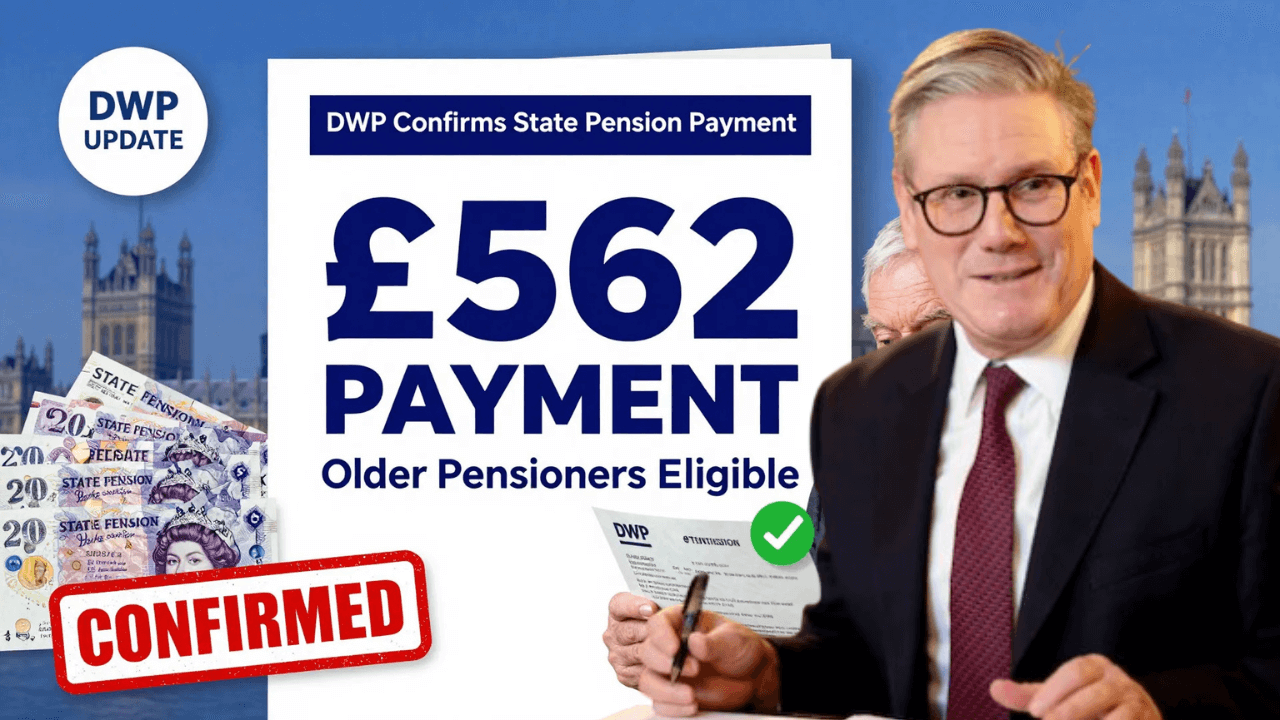
For many older people in the UK, the State Pension is the foundation of everyday life. It pays for food shopping, helps with energy bills, and provides a sense of security in retirement. That is why headlines claiming the DWP has officially confirmed a £562 State Pension payment for older pensioners have quickly caught attention.
At first glance, £562 sounds like a major change. Some pensioners wonder whether this is a new weekly pension rate, a special increase, or a one‑off payment. Others worry because their own payment does not match that figure.
The truth is more practical and less dramatic than many viral posts suggest. A £562 payment can be real, but it usually does not mean the weekly State Pension has suddenly increased to £562 for everyone. In most cases, it relates to how pensions are paid and how different types of support can add up.
This article explains what the £562 figure really means, who might see this amount, how State Pension payments work, and what older pensioners should check to avoid confusion.
Why the £562 State Pension figure is being shared so widely
A specific number like £562 feels official. It looks precise, not rounded, which makes people believe it must come directly from the DWP. When combined with phrases like “officially confirmed” and “older pensioners”, it creates urgency and hope at the same time.
For pensioners living on a fixed income, any suggestion of a higher payment is naturally welcome. But social media and fast‑moving news sites often focus on the headline number without explaining the context behind it.
This is why the same figure can cause excitement for some people and disappointment for others.
Understanding how the UK State Pension works
The UK State Pension is not a flat payment that everyone receives in the same way. Your State Pension depends mainly on your National Insurance record.
In simple terms, the amount you receive is influenced by:
- how many qualifying years of National Insurance you have
- whether you qualify for the full or partial State Pension
- whether your pension is paid weekly or every four weeks
- whether you receive any additional support
This means two pensioners of the same age can receive very different amounts.
Is £562 a new weekly State Pension rate
No. For most pensioners, £562 is not a weekly State Pension rate.
If the UK government introduced a standard weekly State Pension of £562, it would be one of the biggest welfare changes in decades and would be announced clearly across all major news outlets. There would be no uncertainty about it.
Instead, £562 is far more likely to be a payment total, not a weekly rate.
The most common explanation: a four‑weekly payment
Many older pensioners are paid their State Pension every four weeks, not monthly in the usual calendar sense and not always weekly.
When payments are made every four weeks, the amount looks much larger because it covers a full four‑week period in one go.
For example:
- around £140 per week × 4 weeks = about £560
- a slightly higher weekly rate × 4 weeks = around £562
This means a pensioner might see £562 land in their bank account even though their weekly pension has not changed at all.
This is the most common reason why the £562 figure appears.
Why some pensioners are paid every four weeks
The DWP uses different payment schedules depending on when a person first claimed and how their record is set up. Many long‑term pensioners have always been paid every four weeks on the same weekday.
This system is consistent, but it can be confusing when people compare payments with friends or see large figures mentioned online.
A four‑weekly payment can easily be mistaken for a new increase if the context is missing.
What “older pensioners” usually means in headlines
The phrase “older pensioners” is often used loosely. It does not mean there is a separate State Pension rate just because someone is older.
In many cases, the phrase is used because:
- older pensioners are more likely to be on long‑standing payment schedules
- they are more likely to receive additional support
- the wording creates emotional impact
But the State Pension itself does not automatically increase simply because someone is in their late seventies, eighties, or nineties.
Could £562 include more than just the State Pension
In some situations, yes.
Some pensioners receive extra support alongside the State Pension, which can increase the total amount of money arriving in their account around the same time.
This support can include:
- Pension Credit
- Attendance Allowance
- other linked support paid on a similar schedule
If two payments arrive close together, or on the same day, it can look like one larger “pension payment” when it is actually more than one entitlement.
This is another reason why figures like £562 appear in real bank statements.
Pension Credit and why it matters so much
Pension Credit is one of the most important benefits for older pensioners on low incomes. Many people do not claim it because they assume they will not qualify.
Common assumptions include:
- owning a home means you are not eligible
- having some savings means you are not eligible
- having a small private pension means you are not eligible
In reality, many pensioners qualify for Pension Credit without realising it. Even a small award can make a difference and can sometimes unlock extra help.
When Pension Credit is added to the State Pension, the total weekly or four‑weekly income can rise noticeably.
Why one pensioner receives £562 and another does not
This is one of the most frustrating aspects for many people.
The difference usually comes down to:
- different National Insurance records
- different payment schedules
- extra support received by one person but not another
- different household circumstances
It is not usually because one person is “chosen” over another. It is simply how the system calculates entitlement.
What to do if you expected £562 but did not receive it
If you saw this figure online and thought it applied to you, the best approach is calm and practical.
Start by checking:
Your payment schedule
Look at your recent payments. Are you paid weekly or every four weeks? If you are paid weekly, you will not see a four‑weekly total like £562 in one payment.
Your usual payment amount
Compare your latest payment with previous ones. If it is consistent, nothing has changed.
Whether you receive any top‑ups
If you receive Pension Credit or other support, check whether payments arrive separately or together.
Any recent letters
If the DWP changes your entitlement, they usually send a letter or message explaining it.
Why viral pension headlines often cause confusion
Online headlines are written to get attention. Words like “officially confirmed”, “approved”, and “older pensioners” make a story spread faster, even if the information is incomplete.
In many cases, the number in the headline is not wrong, but it is not universal. It applies to some people, in some situations, not everyone.
This is why relying only on headlines can lead to disappointment.
Be careful of scams using pension payment figures
Whenever a specific pension amount becomes popular online, scammers often copy it.
Be cautious of messages that say:
- “Your £562 pension payment is waiting”
- “Confirm your bank details to receive it”
- “Click here to claim your increased pension”
- “Pay a fee to release your payment”
The DWP does not ask for bank details through random links or messages. If something feels rushed or threatening, it is safer to ignore it.
Key things older pensioners should remember
- £562 is most often a four‑weekly payment total, not a weekly pension rate
- The State Pension is not the same for everyone
- Payment schedules can make amounts look larger than they are
- Extra support can increase total income for some pensioners
- Headlines rarely explain personal entitlement differences
- Always check your own payment history rather than relying on social media
Final thoughts
The headline “DWP officially confirms £562 State Pension payment for older pensioners” can sound like a major national change, but in most cases it reflects how pensions are paid rather than a brand‑new pension rate.
For many older pensioners, £562 is simply the result of a four‑weekly payment cycle or the combination of different support payments arriving together. It does not mean that every pensioner will now receive £562, and it does not usually signal a sudden increase in weekly pension rates.
The safest and most reliable way to understand your pension is to focus on your own entitlement, payment schedule, and any letters you receive. That way, you stay informed without unnecessary worry.