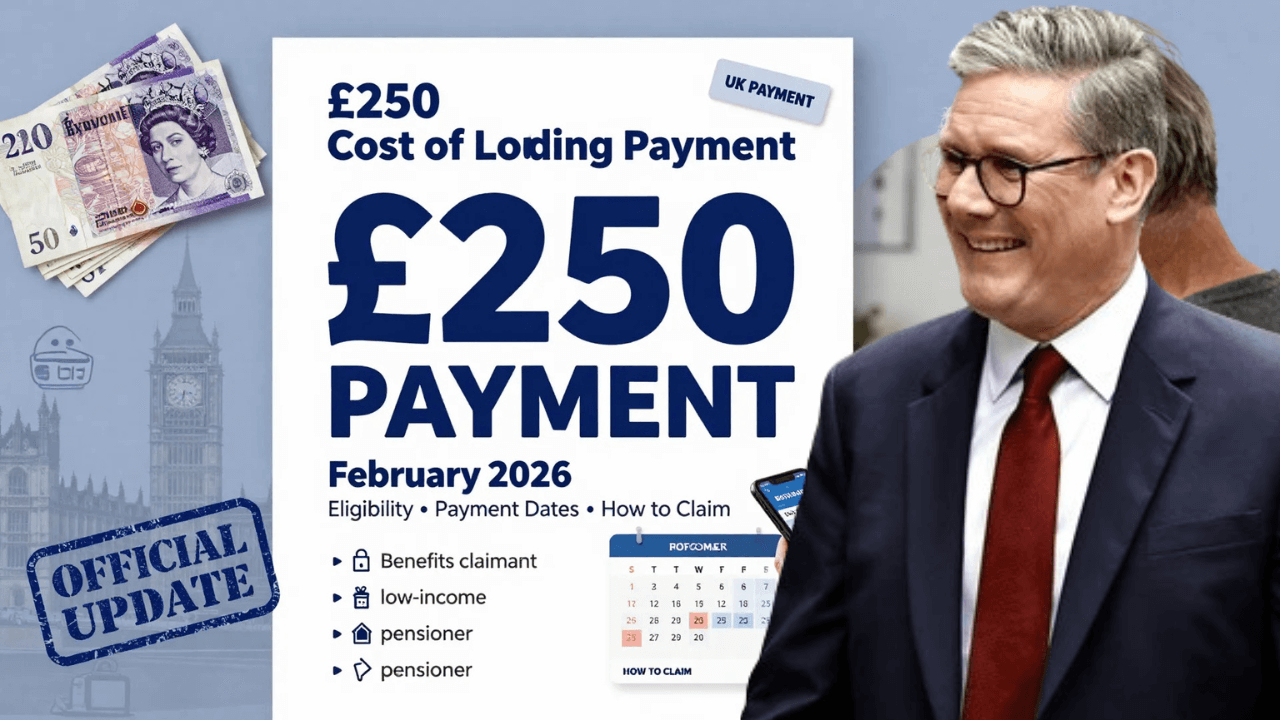
As household budgets across the UK remain under pressure, any mention of a new Cost of Living Payment quickly attracts attention. Rising food prices, energy bills, rent, and everyday essentials continue to affect millions of people, particularly those on low or fixed incomes. That is why headlines talking about a £250 Cost of Living Payment in February 2026 have been widely shared and discussed.
Many people are now asking important questions. Is the £250 payment officially confirmed? Who will be eligible to receive it? When will it be paid? And will people need to apply, or will it be paid automatically?
The answers are not always clear from short headlines or social media posts. This article explains the full picture in plain, easy‑to‑understand English, focusing on what the £250 payment means, who could qualify, how payment dates usually work, and what people should realistically expect in February 2026.
Why cost of living payments still matter in 2026
The cost of living crisis did not disappear overnight. While inflation has fluctuated, many households still struggle with the long‑term impact of higher prices. Energy costs remain unpredictable, food shopping costs more than it did a few years ago, and rents have continued to rise in many areas.
For people receiving benefits, pensions, or low wages, even small changes in monthly income can make a real difference. Cost of Living Payments were introduced to provide temporary financial support during periods of exceptional pressure. Over time, they have become a familiar form of targeted help for those most affected.
That is why any new figure, such as £250, immediately raises hopes and concerns.
Is the £250 Cost of Living Payment officially confirmed
The most important thing to understand is that not every headline reflects a brand‑new nationwide payment for everyone.
A £250 Cost of Living Payment can appear in discussions for several reasons:
- as a proposed support amount
- as an example of a typical payment
- as a locally delivered or targeted support figure
- as part of combined or phased payments
In most cases, such payments are not universal and are linked to specific eligibility criteria. Cost of Living Payments in the past have always been targeted rather than paid to every UK resident.
So while £250 is a realistic support amount, it does not automatically mean every household will receive it.
Who usually qualifies for Cost of Living Payments
Cost of Living Payments in the UK are generally aimed at people who are already receiving certain benefits or financial support. Eligibility is usually determined automatically based on benefit records.
Groups that are commonly included are:
- people receiving means‑tested benefits
- low‑income households
- pensioners receiving certain income‑related support
- disabled people receiving qualifying benefits
Examples of benefits often linked to Cost of Living Payments include:
- Universal Credit
- Pension Credit
- income‑related Employment and Support Allowance
- income‑based Jobseeker’s Allowance
- Income Support
- certain disability‑related benefits
Eligibility is normally assessed during a specific qualifying period.
Does everyone on benefits get the £250 payment
No.
Cost of Living Payments are not paid to everyone on benefits automatically. Eligibility depends on:
- which benefit you receive
- whether it is means‑tested
- whether you were entitled during the qualifying period
- whether your claim was active and eligible
This is why two people receiving different types of support may have very different outcomes.
Why February 2026 is mentioned
February is often mentioned because it falls in the middle of winter, when household costs are traditionally higher. Energy usage peaks, heating bills rise, and financial pressure increases after the Christmas period.
In previous years, Cost of Living support has been issued in stages rather than as a single payment. February is a common time for one of those stages, especially if the government chooses to spread support across the year.
So when February 2026 appears in headlines, it usually refers to timing, not a new rule starting on that exact date.
How Cost of Living Payments are normally paid
One of the most reassuring aspects of Cost of Living Payments is that people usually do not need to apply.
If you are eligible, the payment is normally:
- paid automatically
- sent to the same bank account as your benefit
- clearly labelled on your bank statement
This system is designed to avoid complicated applications and ensure support reaches people quickly.
If a £250 payment is issued, it would almost certainly follow the same automatic process.
What payment dates usually look like
Cost of Living Payments are not paid on the same day for everyone.
Instead:
- payments are made over a period of days or weeks
- people receive the money on different dates
- payment timing depends on benefit systems
This is why some people see payments earlier than others and why confusion often arises on social media when one person has been paid and another has not.
If a payment is scheduled for February 2026, it would likely be paid in stages throughout the month.
Why some people receive nothing even when payments are announced
This is one of the most frustrating issues for many households.
You may not receive a Cost of Living Payment if:
- you were not eligible during the qualifying period
- your benefit is not a qualifying benefit
- your claim was suspended or closed
- you only receive non‑means‑tested benefits
This does not mean a mistake has been made. It usually reflects the eligibility rules.
Pensioners and the £250 payment
Pensioners often worry they will be excluded from cost of living support. In reality, pensioners who receive Pension Credit are usually included in Cost of Living Payments.
However:
- pensioners who only receive the State Pension are not always included
- eligibility depends on income‑related support, not age alone
This is why Pension Credit is so important. It not only boosts weekly income but can also unlock access to extra support payments.
Disabled people and additional support
Disabled people may qualify for Cost of Living Payments through:
- means‑tested benefits
- disability‑related benefits
- combined entitlement
In some years, disability‑specific payments have been made separately from general Cost of Living Payments. A £250 figure may represent a general payment, not a disability‑only payment.
Will the £250 payment affect other benefits
Cost of Living Payments are usually:
- tax‑free
- not counted as income
- not deducted from benefits
This means receiving the payment should not reduce your regular benefit entitlement.
This design ensures the payment provides real additional help rather than creating problems elsewhere.
Do people need to claim the £250 payment
In almost all cases, no claim is required.
If you are eligible:
- the payment is automatic
- no forms are needed
- no phone calls are required
Be very cautious of messages asking you to “claim” or “apply” through links. These are often scams.
Common scams linked to Cost of Living Payments
Whenever Cost of Living Payments are discussed, scammers quickly take advantage.
Be alert to messages that say:
- “Apply now for your £250 payment”
- “Confirm your details to receive payment”
- “Your £250 payment is waiting”
- “Pay a fee to release your support”
Genuine payments are handled by official government systems and do not require upfront action.
Why headlines about payments can be misleading
Headlines often focus on a single figure without context. A £250 payment might be:
- part of a wider support package
- one instalment of multiple payments
- targeted at a specific group
- conditional on eligibility
Without explanation, readers may assume it applies to everyone, which is rarely the case.
What people should do now
If you are worried about whether you might receive a £250 Cost of Living Payment in February 2026, the most sensible steps are simple.
- make sure your benefit claim is up to date
- report changes in circumstances promptly
- check messages in your online account if you have one
- read official letters carefully
- ignore unofficial social media rumours
Doing these things ensures you do not miss support you are entitled to.
What to expect if no payment arrives
If February 2026 passes and you do not receive a payment, it does not automatically mean something has gone wrong.
Possible reasons include:
- you were not eligible
- payments are still being rolled out
- your benefit does not qualify
In most cases, eligible payments arrive without delay or action.
Why cost of living support remains under review
Cost of Living Payments are not permanent benefits. They are temporary measures designed to respond to economic conditions.
That is why:
- amounts change
- eligibility changes
- payment schedules change
A £250 payment reflects ongoing pressure but does not guarantee future payments at the same level.
Key points to remember
- £250 Cost of Living Payments are targeted, not universal
- Eligibility is usually linked to means‑tested benefits
- Payments are automatic if you qualify
- February 2026 refers to timing, not a deadline to apply
- No legitimate payment requires an application or fee
- Headlines often oversimplify complex rules
Final thoughts
The idea of a £250 Cost of Living Payment in the UK in February 2026 offers hope to many households facing continued financial strain. While such a payment is realistic and consistent with past support measures, it is important to understand that it would apply only to eligible groups, not everyone.
The safest approach is to stay informed, rely on official communication, and avoid panic caused by incomplete headlines. For those who qualify, support usually arrives automatically. For those who do not, it does not mean help will never come — only that support is targeted where it is considered most needed.