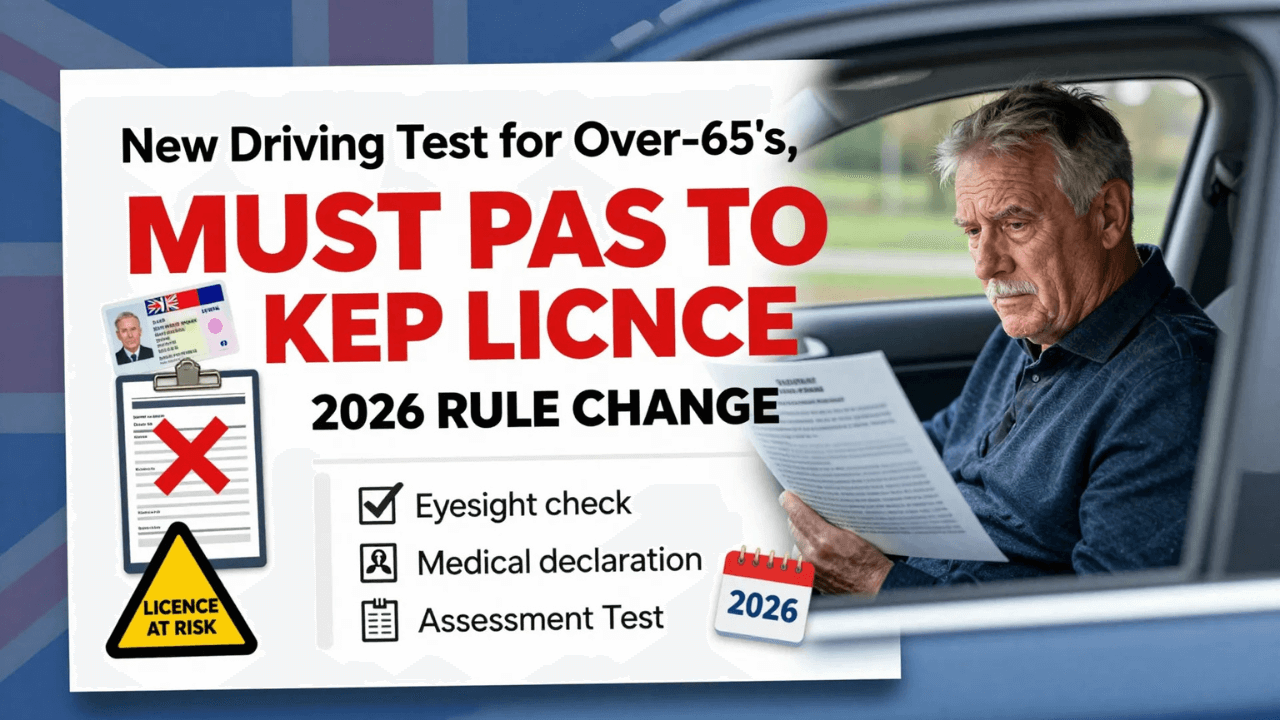
Claims that UK drivers over the age of 65 will be forced to pass a new test in 2026 to keep their driving licence have been spreading quickly online. For many older drivers, these headlines are worrying. Driving is closely tied to independence, daily routine, and quality of life, so the idea of a compulsory test can feel threatening.
Some people are asking whether they will suddenly have to sit another driving test. Others fear their licence could be taken away automatically just because of their age. A few are even wondering whether they should stop driving altogether before new rules come in.
The reality is far calmer and far more practical than the headline suggests. There is no blanket new test for all over‑65 drivers in 2026, and there is no age‑based rule that forces people to re‑sit a driving test simply because they are older.
This article explains what is really happening, where the confusion comes from, what the rules actually say, and what older drivers in the UK genuinely need to know.
Why the “new test in 2026” headline is spreading
Age‑related driving stories attract attention very quickly. When words like “must pass,” “new test,” and “licence at risk” appear together, they trigger fear and urgency.
In most cases, these headlines are built around a misunderstanding of existing rules, combined with increased discussion about road safety and an ageing population. Add a future year like 2026, and the story feels official and unavoidable.
However, headlines rarely explain the difference between:
- a mandatory test for everyone, and
- individual assessments that already exist
That difference is crucial.
The key fact upfront
To be absolutely clear:
There is no new law in 2026 that forces all UK drivers over 65 to pass a test to keep their licence.
Age alone does not trigger a driving test in the UK.
How driving licences actually work in the UK
In the UK, driving licences are not issued for life without checks. They are managed through renewal and self‑declaration, overseen by DVLA.
The system is based on fitness to drive, not age.
This means the law focuses on whether a person can drive safely, not how old they are.
What happens at age 70 (the real milestone)
One of the biggest sources of confusion is the difference between 65 and 70.
There is nothing special that happens at 65 in UK driving law.
At 70, drivers must renew their driving licence. This renewal:
- is free
- does not involve a driving test
- does not require a routine medical exam
Instead, drivers must:
- confirm their personal details
- declare whether they have any medical conditions that affect driving
- confirm they meet the eyesight standard
Once renewed, the licence is usually valid for three years, after which it must be renewed again.
This process has been in place for many years and is not new for 2026.
Is there a compulsory driving test at 70 or over?
No.
UK drivers are not required to retake a driving test at 70, 75, 80, or any other age simply because of age.
There is no automatic theory test, hazard perception test, or on‑road driving test linked to age.
So where does the idea of a “new test” come from?
The idea usually comes from three real but misunderstood things.
Medical fitness assessments
Drivers of any age must tell the DVLA if they develop a medical condition that could affect driving. Examples include:
- serious vision problems
- certain heart conditions
- neurological conditions
- episodes of fainting or blackouts
If a condition is reported, the DVLA may:
- request medical evidence
- ask a doctor for a report
- request an individual driving assessment
This is not age‑based. A 30‑year‑old and a 75‑year‑old are treated the same under the law.
Individual driving assessments
In rare cases, a driving assessment may be requested if there are specific safety concerns. This might happen after:
- a medical report
- concerns raised by healthcare professionals
- serious driving incidents
These assessments are case‑by‑case, not blanket tests for everyone over a certain age.
Road safety discussions and consultations
From time to time, the government and safety bodies discuss ways to improve road safety. These discussions are often reported as if decisions have already been made.
In reality, discussion is not the same as law.
There is currently no approved policy that introduces a universal test for over‑65 drivers in 2026.
What February or 2026 actually represents
When future dates are mentioned, they often relate to:
- guidance updates
- awareness campaigns
- administrative improvements
- consultation timelines
These are not the same as new compulsory tests.
Using a future year in a headline makes a story sound official, even when no new rule exists.
What older drivers are legally required to do
While there is no new test, older drivers do have responsibilities, just like everyone else.
Reporting medical conditions
If you develop a condition that could affect driving, you must inform the DVLA. Failing to do so can result in:
- fines
- licence withdrawal
- insurance problems
This rule applies at all ages.
Eyesight standards
Drivers must be able to:
- read a number plate from the required distance
- use glasses or contact lenses if needed
There is no compulsory eye test at a certain age, but drivers are expected to self‑monitor and act responsibly.
Licence renewal on time
At 70, and every three years after, drivers must renew their licence. Missing a renewal can invalidate the licence.
Why older drivers are not automatically considered unsafe
UK law recognises that many older drivers are:
- highly experienced
- cautious
- familiar with road rules
- less likely to engage in risky behaviour
Age alone is a poor predictor of unsafe driving. That is why the UK uses medical fitness and competence, not birthdays.
Insurance vs licence confusion
Another source of fear comes from insurance.
Insurance premiums may increase with age, but this has nothing to do with licence validity.
An insurer charging more does not mean your licence is at risk.
Common myths to ignore
There are several myths currently spreading online.
“All over‑65s must take a test in 2026”
False. No such rule exists.
“Your licence will be cancelled if you fail a new test”
False. There is no automatic test.
“Drivers are banned after 70”
False. Renewal is required, not removal.
“Doctors decide who can drive after 65”
False. Doctors provide information; the DVLA makes decisions based on evidence.
Why these headlines can be harmful
Fear‑based headlines can cause real stress. Some older drivers:
- stop driving unnecessarily
- lose confidence
- feel anxious about routine renewals
- become targets for scams
Scammers often use fake messages like:
- “You must pass the new test to keep your licence”
- “Pay now to secure your licence”
- “Confirm details to avoid cancellation”
These are not legitimate.
What older drivers should actually do
Instead of worrying about headlines, focus on practical steps.
Check your licence expiry date
Know when renewal is due.
Monitor your health honestly
If something changes, check whether it needs to be reported.
Have regular eye tests
Not because of a new rule, but because good vision matters.
Ignore social media panic
Wait for confirmed official announcements.
Use official channels only
Never respond to random messages about your licence.
What would happen if rules ever did change
If the UK ever introduced a major change like compulsory testing for older drivers, it would:
- be debated publicly
- go through Parliament
- be announced years in advance
- appear clearly on official government websites
It would not arrive suddenly through viral headlines.
Why age‑based testing remains unlikely
There are strong reasons why the UK avoids age‑based testing:
- it risks discrimination
- it does not reliably improve safety
- it ignores individual ability
- it could overwhelm testing systems
That is why the UK continues to focus on individual fitness, not age thresholds.
Key points to remember
- There is no new 2026 test for over‑65 drivers
- Age alone does not trigger a driving test
- Licence renewal at 70 is normal and unchanged
- Medical reporting applies at all ages
- Headlines exaggerate discussions into “rules”
- Official changes are always clearly announced
Final thoughts
The headline “UK over‑65 drivers face new 2026 test – must pass to keep their licence” sounds alarming, but it does not reflect reality.
There is no compulsory new test, no mass licence removal, and no age‑based rule coming into force in 2026. What exists is a long‑standing system focused on safety, medical fitness, and responsible renewal — the same system that has applied for years.
For older drivers who renew on time, monitor their health, and drive responsibly, nothing dramatic is changing. The best response is to stay informed, rely on official information, and not let fear‑driven headlines undermine confidence or independence.